Your Shoes Are Messing With Your Neck: The Surprising Chain Reaction Starting at Your Feet

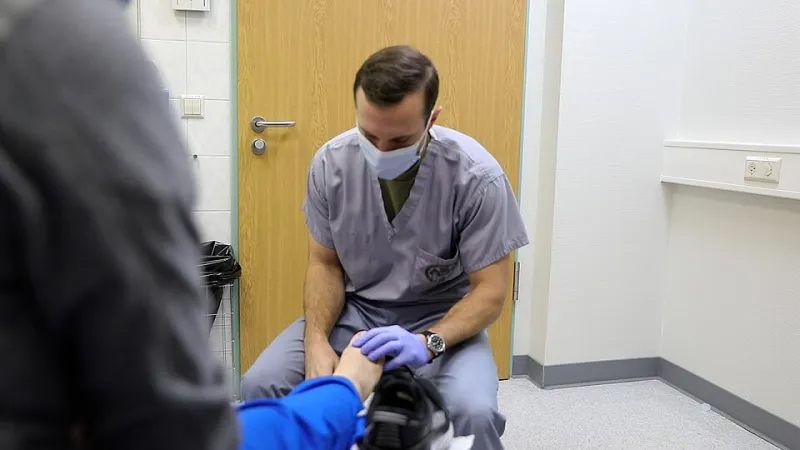
Photo: Romainbehar, CC0, via Wikimedia Commons
You've probably heard the usual advice for neck and shoulder pain: sit up straighter, put your phone down, get a better pillow. What nobody mentions — not your chiropractor, not your coworker who's suddenly obsessed with ergonomics — is that the shoes on your feet might be the biggest troublemaker of all.
It sounds wild. Your feet are at the bottom, your neck is at the top. What could they possibly have to do with each other? As it turns out, quite a lot.
The Body Is One Big Connected System
Physical therapists have a term for it: the kinetic chain. Basically, every joint and muscle group in your body influences the ones above and below it. When something goes wrong at the foundation — meaning your feet — the rest of the structure has to compensate.
Think of it like a building with a slightly uneven foundation. The walls don't crack right away, but over time, stress accumulates in unexpected places. Your body works the same way. Flat, unsupportive shoes allow your arches to collapse inward, which tilts your ankles. That tilt rotates your knees inward, which tips your pelvis forward. A forward-tilting pelvis causes your lower back to arch excessively. And to compensate for that, your upper back rounds, your shoulders creep forward, and your neck juts out like you're trying to read a menu from across the restaurant.
Physical therapists call that last part "forward head posture," and it's a lot more serious than it sounds. For every inch your head moves forward of its natural position, the effective weight your neck muscles have to support nearly doubles. That's what's behind those persistent headaches, the tightness between your shoulder blades, and that nagging ache at the base of your skull.
So What Does This Have to Do With Your Shoes?
Everything, actually. Shoes that lack arch support, cushioning, or proper heel alignment set off that chain reaction from the very first step. And in the US, where the average adult logs somewhere between 3,000 and 5,000 steps a day just going about their normal routine, those bad mechanics compound fast.
Flimsy flip-flops, paper-thin flats, and worn-out sneakers are common offenders. But even well-known athletic brands can fall short if the shoe doesn't match your foot's specific needs. Overpronators — people whose arches roll inward — are especially vulnerable to the chain reaction described above. And overpronation is incredibly common, affecting an estimated 70% of Americans to some degree.
Real People, Real Relief
Ask around in FitFlop communities and forums, and you'll find story after story of people who fixed nagging upper-body pain by addressing what was on their feet.
Take Dana, a 44-year-old teacher from Columbus, Ohio, who spent two years getting massages and adjustments for chronic shoulder tension. "My physical therapist finally asked me to bring in my shoes," she says. "She took one look at the wear pattern on my flats and said, 'There's your problem.' I switched to FitFlops for my classroom days, and within about six weeks, the shoulder thing had basically resolved itself."
Or consider Marcus, a 51-year-old retail manager in Phoenix who was convinced his neck pain was from sleeping wrong. "I'd tried every pillow on the market. Nothing worked." A friend suggested he look at his footwear — he was spending eight-plus hours a day on concrete floors in unsupportive sneakers. After switching to a pair of FitFlop trainers with proper midsole support, he noticed a difference within a month. "I'm not saying it was magic, but the neck pain went from a daily thing to something I barely think about."
What Physical Therapists Actually Recommend
PTs who specialize in musculoskeletal issues will often start a postural assessment at the feet. They're looking at arch height, heel strike patterns, and how the ankle moves during walking. From there, they can trace the chain upward to identify where compensations are happening.
The general guidance from most practitioners is consistent: look for shoes that offer genuine arch support (not just a soft insole), a stable heel counter, and enough cushioning to absorb impact without sacrificing ground feedback. Shoes that are too rigid can be just as problematic as shoes that are too soft — your foot needs to move naturally, just with appropriate support throughout the motion.
FitFlop's biomechanical design philosophy lines up closely with these recommendations. Their Microwobbleboard and later midsole technologies were specifically engineered to distribute pressure more evenly across the foot, reduce excessive pronation, and encourage a more natural gait cycle. That's not marketing language — it's the kind of thing that shows up in independent gait analysis studies.
The Cost of Ignoring It
Here's where things get financially uncomfortable. Chronic neck and shoulder pain is one of the leading reasons Americans visit physical therapists, chiropractors, and orthopedic specialists. A single PT session can run $150 or more without insurance. Chiropractic adjustments, massage therapy, prescription anti-inflammatories — it adds up shockingly fast.
If the root cause is postural, and the posture issue traces back to unsupportive footwear, then addressing the shoes first isn't just smart — it's potentially the most cost-effective intervention available. A quality pair of FitFlops, especially snagged at a sale price, is a fraction of what most people spend on reactive treatments for pain they could have prevented.
Small Change, Big Results
None of this means your shoes are the only factor in posture and pain. Screen time, sedentary work, stress, and sleep all play roles. But footwear is one of the most actionable changes most people can make — and one of the most overlooked.
If you've been dealing with nagging neck stiffness, tightness across the upper back, or headaches that seem to come out of nowhere, it's worth taking a hard look at what you're wearing on your feet before you book another appointment or buy another pillow.
Start with the foundation. Everything else builds from there.
Looking for a FitFlop style that fits your daily routine? Browse current deals on our site — we track sales and markdowns so you can find the right pair without overpaying.