Penny-Wise, Pound-Foolish: What Cheap Shoes Are Really Costing Your Feet (and Your Wallet)
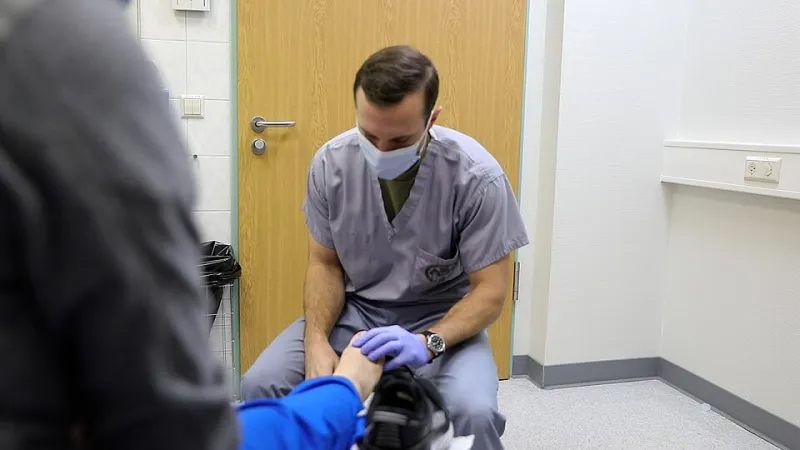
Photo: Marcy Sanchez, Public domain, via Wikimedia Commons
Let's be honest: when you're standing in the shoe aisle staring at a $28 pair of flats next to a $130 pair of supportive sandals, the budget option feels like a no-brainer. You're saving over a hundred dollars right there. But what if that "savings" is actually setting you up for a much bigger bill down the road — one that arrives not at the register, but at your doctor's office?
That's exactly what podiatrists across the country say they're seeing every day in their clinics. Patients who've spent years cycling through cheap, unsupportive footwear are showing up with plantar fasciitis, stress fractures, bunions, and chronic back pain — conditions that can take months and thousands of dollars to treat. And in many cases, the root cause traces directly back to the shoes on their feet.
What "Cheap" Actually Means for Your Foot Health
Budget shoes — we're talking the sub-$40 flats, foam flip-flops, and fashion sneakers that dominate fast-fashion retailers — are typically built with one priority: looking good at a low price point. Arch support, cushioning depth, and biomechanical engineering are afterthoughts, if they're considered at all.
Dr. Sarah Kline, a podiatrist based in Austin, Texas, puts it bluntly: "I can usually tell within the first few questions of a patient intake whether they're a chronic cheap-shoe buyer. The pattern of complaints is remarkably consistent — heel pain, ball-of-foot soreness, knee issues that seem unrelated to the foot. But they almost always are related."
The problem isn't just discomfort. It's structural. When a shoe lacks proper arch support, your foot pronates (rolls inward) excessively with every step. Over thousands of steps a day — the average American takes between 4,000 and 8,000 — that misalignment travels up the kinetic chain: ankles, knees, hips, and lower back all compensate. The result is a cascade of wear that doesn't show up immediately, but compounds over time like interest on a bad loan.
Running the Numbers: A Real Cost Comparison
Here's where it gets eye-opening. Let's walk through a realistic financial scenario for two hypothetical shoppers over five years.
Shopper A buys cheap shoes — let's say three to four pairs per year at an average of $35 each. That's roughly $140 annually, or $700 over five years. Sounds reasonable, right?
But Shopper A starts developing plantar fasciitis in year two. A single podiatry visit averages $300–$400 without insurance, and most patients need multiple appointments. Physical therapy for foot and ankle issues runs $150–$250 per session, and a typical course involves 6–12 sessions. Add in custom orthotics (often $400–$800 per pair), over-the-counter pain medications, and potentially a cortisone injection or two, and you're looking at a conservative estimate of $2,000–$4,500 in treatment costs — and that's assuming nothing escalates to surgery.
Shopper B invests in quality comfort footwear — say, two pairs of FitFlops per year at roughly $100–$130 each. That's $200–$260 annually, or $1,000–$1,300 over five years. They experience significantly less foot fatigue and avoid the injury spiral entirely.
The math is uncomfortable: Shopper A's "budget" approach can end up costing three to five times more than Shopper B's upfront investment, once you factor in medical bills.
Dr. Marcus Webb, an orthopedic specialist in Chicago, notes that the break-even point is often sooner than people expect. "If someone switches to genuinely supportive footwear and avoids just one round of physical therapy, they've already come out ahead financially. And that's before you account for lost productivity, missed workdays, or the quality-of-life toll of chronic foot pain."
The Hidden Costs Nobody Talks About
Medical bills are the obvious financial hit, but the costs of cheap shoes go beyond copays and prescriptions.
Lost productivity is a real factor. Chronic foot pain is one of the leading causes of reduced workplace performance among adults under 60. When your feet hurt, you move less, stand less, and often make accommodations — like sitting more than you should — that create secondary issues.
Mental health impacts are also underreported. Living with persistent pain, even low-grade discomfort, takes a psychological toll. Studies have linked chronic pain conditions to elevated rates of anxiety and depression, both of which carry their own treatment costs.
The replacement treadmill is another sneaky expense. Cheap shoes wear out faster — often within three to six months of regular use — meaning you're buying more frequently than you might realize. That $35 pair you replace four times a year is actually costing you $140, while a quality pair that lasts 12–18 months with proper care starts looking like the better deal.
What Quality Footwear Actually Provides
This is where brands like FitFlop earn their reputation. The biomechanical design built into FitFlop footwear — including the multi-density midsoles, anatomically shaped footbeds, and structured heel cups — isn't marketing language. It's engineering that mimics what custom orthotics do, distributing pressure more evenly across the foot and reducing the strain that accumulates with every step.
For comfort-first shoppers, the value proposition isn't just about avoiding pain. It's about maintaining mobility, staying active, and not spending your weekends on the couch because your feet gave out by Thursday.
"I regularly recommend FitFlops to patients who need supportive daily footwear but can't afford custom orthotics right now," says Dr. Kline. "They're not a medical device, but for a lot of people, they're a genuinely effective preventive measure."
How to Make the Switch Without Breaking the Bank
If you're currently in the cheap-shoe cycle and want to shift toward quality footwear without a massive upfront hit, there are smart ways to do it.
- Shop sale cycles strategically. FitFlop regularly discounts seasonal styles, and sites like FitFlop Sale Hub track those deals so you can grab quality pairs at significantly reduced prices.
- Start with one everyday pair. You don't need to overhaul your entire closet at once. Pick your highest-mileage shoe — the one you wear most days — and upgrade that first.
- Think cost-per-wear. A $120 pair you wear 200 days costs you $0.60 per wear. A $35 pair you wear 60 days before they fall apart costs $0.58 — roughly the same, but with none of the foot support.
- Check FSA/HSA eligibility. Some supportive footwear and insoles qualify for Flexible Spending Account or Health Savings Account purchases, which effectively gives you a tax discount on the investment.
The Bottom Line
There's no judgment here for anyone who's been buying cheap shoes — most of us have done it, and the short-term savings feel very real. But the evidence from podiatrists, orthopedic specialists, and basic math tells a consistent story: the true cost of unsupportive footwear almost always exceeds the sticker price once you account for what it does to your body over time.
Investing in quality comfort footwear isn't an indulgence. For most people who spend significant time on their feet, it's genuinely the more financially sensible choice — especially when you know where to find the best deals on brands that are built to last and designed to support you every step of the way.